
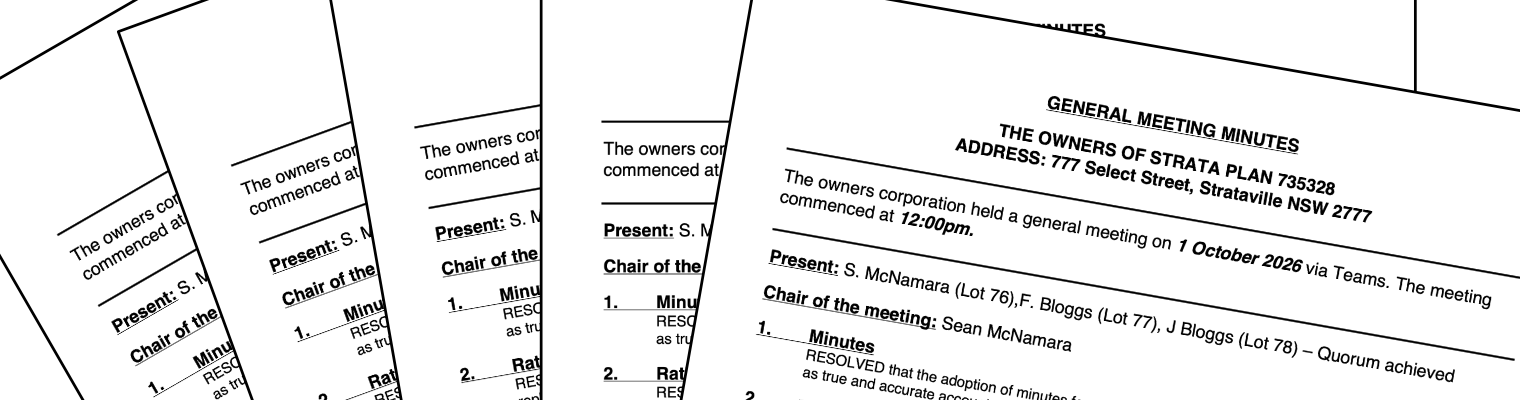
With e-mails often being absent, minutes would likely be the next most useful items seen when inspecting books and records.
There are still some misconceptions about minutes within a strata context, so let’s start with Wiktionary’s view:
- The official notes kept during a meeting
That’s a start, but it’s certainly not the whole story.
The most important aspect of strata meeting minutes is that they record what is:
- Able to be acted on
The minutes of strata meetings are not meant to record or summarise the conversation which occurred at the meeting.
If the ideal strata motion reads simply “That the owners corporation resolves to do [action]”, then that would flow directly to the minutes simply as:
- Resolved that the owners corporation do [action].
- Specially resolved that the owners corporation do [action].
- Unanimously resolved that the owners corporation do [action].
- Defeated that the owners corporation do [action].
- Deferred that the owners corporation do [action].
If a motion is amended, the minutes should read, for example, “Resolved as amended that the owners corporation do [action]”.
Note: there are only some matters which require unanimous resolutions, and they’re scattered throughout the Act – day-to-day, ordinary and special resolutions are the norm.
Attempting to summarise conversations (or relay them verbatim, à la parliaments’ Hansard) is fraught with difficulties, not only in actually capturing everything said, but even in just summarising them in a fair manner. Inadvertent misunderstanding, or missing individual elements could end up causing no end of grief for the Secretary, and the owners corporation, if those interpretations or omissions are challenged.
The usual structure of the minutes is:
- Description of meeting/minutes type (“General Meeting Minutes”)
- Owners corporation details (strata plan number and address)
- Details of venue/method of holding
- List of those present (stating whether in person, by proxy, or by other methods [e.g. by electronic vote or pre-meeting electronic voting])
- List of apologies and other attendees
- Whether a quorum was present or declared
- The opening time of the meeting
- If the meeting is adjourned, a statement to that effect, the reason for adjournment, and the date the meeting is adjourned to
- The chair of the meeting
- The outcomes of the motions in the order they were considered (including if resolved in any manner as amended)
- The outcomes of any procedural motions proposed at the meeting (those proposed in relation to the conduct of the meeting)
- The time the meeting closed
- The date of the minutes
- Any items tabled at the meeting should be attached to the minutes
It is usual for the first motion of a meeting be one adopting the minutes of the prior meeting of the same type.
This is sometimes inconsistently done, despite there only being two types of meetings in strata:
- general meetings
- strata committee meetings
So for any type of “general meeting” (other than the inaugural general meeting), the minutes of the prior meeting, whether that be the inaugural general meeting (IGM), the first annual general meeting (FAGM), an annual general meeting (AGM), or just an ordinary general meeting (GM – there is no “extraordinary general meeting” in the Act) are those to be considered.
Similarly, a strata committee meeting should consider the minutes of whichever strata committee meeting was last held, even if it’s the one commonly held immediately after the annual general meeting (while a strata committee meeting is commonly held immediately following the AGM [at least to elect office holders {chairperson, secretary, and treasure}], there is no requirement that one be held then).
Minutes may be amended by simple majority if issued minutes have mistakes, so it’s worth checking if the following meeting has adopted minutes as issued or with amendments. If amendments have been resolved, you would want to check that they have been incorporated in the minutes in the books and records (otherwise you may be relying on incorrect information).
Of course, minutes will vary by look and structure based on who prepared them (secretary or strata manager), whether a strata management software product was used or a word processing system, etc., so it can be a little jarring to scroll through the set of minutes for any given owners corporation, but the above may help to tease out the important information as you are inspecting books and records.
The date of the minutes is important to be included as it helps ensure the minutes have been issued within the period required under the Act…but such deadlines, and others required under the Act in relation to levies, meetings, and other matters, is the topic for next week’s post.
Strata Report Giveaway!
Yes, the offer still stands! I will prepare a free strata report (valued at $385!) for a strata scheme in NSW (remote inspection for management agencies outside Sydney metro area) to the first commenter or contact via the details below who can correctly identify why I use the dummy strata scheme SP735328 (other than its unlikelihood to ever be issued!).
This prize is transferable, so if you or someone you know is looking to buy in strata and needs an independent, professional, and thorough strata report, get solving, get in touch, and maybe get some brownie points!
Leave a Reply