
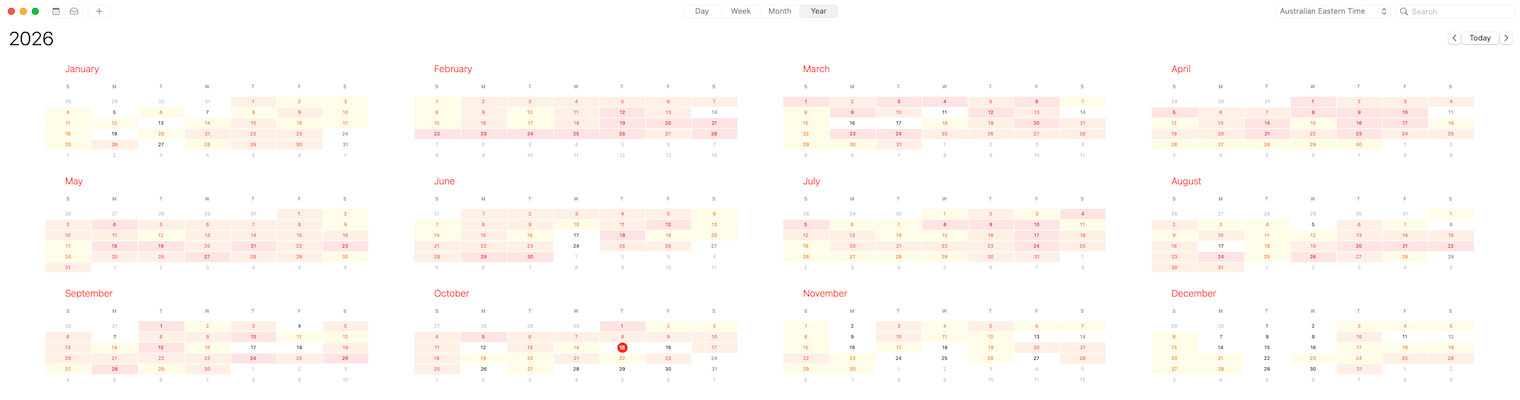
I missed my own “strata deadline” (writing this post) last week due to health reasons, but am back on my feet (or in front of my computer, anyway), so, as promised two weeks ago, this post is about deadlines in strata.
I discussed some of the points in this post on the Strata, Meet Data blog in a couple of posts (Wanna Go On A Date and More Dates Than You Can Handle), but there are some elements which can either be considered inconsistencies in the various Acts…or just (sometimes unexpected) nuances in how the Acts are written and interpreted.
The primary point of this post, however is this:
day vs working day
Trusty Wiktionary helps us again – we are looking at:
- A period of time between two set times which mark the beginning and the end of day in a calendar, such as from midnight to the following midnight
[Ed. in fact, we’re interpreting this definition as more succinctly expressed as “calendar day” on Wiktionary: “1. (law) A timespan of exactly 24 hours, measured from one midnight to the next”]
vs
- Any of those days of a week on which work is done, officially Monday to Friday in many countries
NSW has its own definition of a working day, which is found, as many definitions are for NSW law, in the Interpretation Act 1987, and that definition is found in s76(2):
- In this section—
working day means a day that is not—- a Saturday or Sunday, or
- a public holiday or a bank holiday in the place to which the letter was addressed
And there is our first twist: “a bank holiday”.
Bank holidays are not general public holidays in Australia, but, for any NSW legislation which relies on this section of the Interpretation Act, a bank holiday is considered equivalent to a public holiday.
Thankfully, this is the only place “working day” is used in the Interpretation Act, and it is specific to one thing in particular – service of documents by post, which is covered under s76(1):
- If an Act […] requires any document to be served by post[…], service of the document
[…]- in Australia[…]—is […] taken to have been effected on the seventh working day after the letter was posted
The upshot for strata is that anything which relates to serving documents, if that service is by post (i.e. the address provided is a postal address, not an e-mail address), the day that document is considered delivered or, for notices such as meeting or levy notices, to have taken effect, is the seventh working day after the item is posted.
Post on any day, and the first of those seven working days is the next working day, whether the day of posting is a working day or not. On the seventh day, the document is served, and the recipient is considered to have been notified of its contents or to have received it (no matter whether the address is a PO Box or street address).
For any notices, that means the next day after service (whether working day or not) is Day 1 of the notice period specified in the Act. On the last day of the notice period, the matter in the notice can occur – for example, general meetings which aren’t Annual General Meetings can be held on Day 7 of the notice period (see the Strata Meet Data posts linked above for more examples).
E-mail is considered served on the day it’s sent, so it’s ideal to have e-mail addresses for all required notice recipients to remove the need to account for seven working days’ postage.
This post is getting pretty long already, so I’ll just mention one other “days” quirk in the Act.
Some actions are required to happen within a certain number of days – consider the subject of my last post: meeting minutes.
Minutes of general meetings are required to be issued (or more accurately, “given” to the specified recipients) within 14 days of the meeting – in this case, the issuance is to happen within 14 days, and that does not include the postal allowance, so as long as the minutes are sent by post or e-mail within 14 days (not working days), the Act has been complied with.
Similarly, a general meeting trigged by a “qualified request” under s19(2) is required to be “convened” within 14 days of the receipt of the request. In this sense, convening means “calling” (i.e. doing all things necessary to organise the meeting), not that the meeting needs to be held within 14 days (it would be almost impossible to meet meeting notice periods!).
It is the sending of the notice, by post or by e-mail, that needs to happen within that deadline, and the service of document provisions would then apply to ensure the meeting is held the required number of days after the issuance of the notice.
We’re done on considering dates and notice periods for now – we’ll look at the content of meeting agendas in my next post…currently scheduled to be posted next week!
Strata Report Giveaway!
Yes, the offer still stands! I will prepare a free strata report (valued at $385!) for a strata scheme in NSW (remote inspection for management agencies outside Sydney metro area) to the first commenter or contact via the details below who can correctly identify why I use the dummy strata scheme SP735328 (other than its unlikelihood to ever be issued!).
This prize is transferable, so if you or someone you know is looking to buy in strata and needs an independent, professional, and thorough strata report, get solving, get in touch, and maybe get some brownie points!
Leave a Reply